Introduction
Welding is a fundamental assembly technique used in the manufacturing industry to join metals and thermoplastics by causing coalescence. This process involves melting the base materials, often adding a filler material, and allowing them to cool and fuse together to form a strong joint. Welding is essential in various industries due to its ability to create robust, permanent connections. This article explores the welding process, its benefits, applications, and its critical role in manufacturing and assembly.
Understanding the Welding Process
Welding involves several key steps to ensure the formation of a strong and durable joint:
- Preparation
- Objective: Ensure that the surfaces to be welded are clean and properly aligned.
- Methods: Parts are cleaned to remove any contaminants, such as oils, rust, or paint, which could affect the quality of the weld. Proper alignment and fit-up of the parts are crucial for achieving a strong joint.
- Welding
- Objective: Melt the base materials and, if applicable, the filler material to create a joint.
- Methods: Various welding techniques are used, each with specific equipment and procedures. Common welding methods include MIG (Metal Inert Gas), TIG (Tungsten Inert Gas), and stick welding.
- Cooling
- Objective: Allow the molten materials to solidify and form a strong bond.
- Methods: Cooling can occur naturally in the air, or through controlled cooling techniques to achieve desired mechanical properties.
- Inspection
- Objective: Verify the quality and integrity of the weld.
- Methods: Non-destructive testing methods, such as visual inspection, X-ray, ultrasonic, and dye penetrant testing, are used to ensure the weld meets required standards.
Types of Welding Techniques
- MIG Welding (Metal Inert Gas):
- Process: Uses a continuous wire electrode fed through a welding gun and a shielding gas to protect the weld pool from contamination.
- Applications: Ideal for welding thin to thick materials, commonly used in automotive, construction, and fabrication industries.
- Benefits: High welding speed, ease of use, and suitability for a variety of metals.
- TIG Welding (Tungsten Inert Gas):
- Process: Uses a non-consumable tungsten electrode and an inert gas (usually argon) to protect the weld area.
- Applications: Suitable for welding thin sections of stainless steel, aluminum, and other non-ferrous metals, used in aerospace, automotive, and art metalwork.
- Benefits: Produces high-quality, precise welds with excellent finish.
- Stick Welding (Shielded Metal Arc Welding):
- Process: Uses a consumable electrode coated in flux to lay the weld, with the flux providing a shielding gas and slag to protect the weld pool.
- Applications: Commonly used in construction, maintenance, and repair work, suitable for thick materials and outdoor applications.
- Benefits: Simple equipment, versatility, and effectiveness on rusty or dirty surfaces.
- Spot Welding:
- Process: Joins two overlapping metal sheets by applying pressure and heat to a small area using an electrical current.
- Applications: Widely used in the automotive industry for assembling car bodies.
- Benefits: High-speed production, efficient for sheet metal applications, and requires minimal filler material.
- Flux-Cored Arc Welding (FCAW):
- Process: Similar to MIG welding but uses a tubular wire filled with flux, which provides the shielding gas.
- Applications: Suitable for outdoor welding and welding thicker materials, used in construction and heavy equipment industries.
- Benefits: High deposition rate, can be used without external shielding gas, and effective on dirty or rusty materials.
Benefits of Welding
- Strong Joints:
Welding produces strong, permanent joints that can withstand significant loads and stresses. - Versatility:
Welding can join a wide variety of metals and thermoplastics, making it suitable for numerous applications across different industries. - Efficiency:
Many welding processes are highly efficient, allowing for quick and cost-effective assembly of components. - Flexibility:
Welding can be performed in various environments, including indoors, outdoors, underwater, and in space, providing flexibility for different projects. - Material Savings:
Welding often requires less material than other joining methods, such as mechanical fastening, reducing overall material costs.
Applications of Welding
- Automotive Industry:
- Applications: Manufacturing and assembling body panels, frames, exhaust systems, and engine components.
- Benefits: Provides strong, durable joints essential for vehicle safety and performance.
- Aerospace Industry:
- Applications: Fabricating and repairing aircraft frames, engine parts, and structural components.
- Benefits: Ensures high-strength, lightweight connections that can withstand extreme conditions.
- Construction Industry:
- Applications: Erecting steel structures, bridges, pipelines, and heavy machinery.
- Benefits: Offers robust, load-bearing joints that are essential for structural integrity and safety.
- Manufacturing and Fabrication:
- Applications: Producing machinery, equipment, tools, and metal furniture.
- Benefits: Provides reliable, high-quality joints that enhance the durability and performance of manufactured products.
- Shipbuilding and Marine Industry:
- Applications: Constructing and repairing ships, submarines, and offshore platforms.
- Benefits: Ensures corrosion-resistant, watertight joints essential for marine environments.
- Energy Sector:
- Applications: Building and maintaining power plants, oil rigs, pipelines, and renewable energy installations.
- Benefits: Provides high-strength, durable joints that can withstand harsh operating conditions.
Conclusion
Welding is a key assembly technique that provides strong, reliable, and permanent joints for a wide range of materials. Its versatility, efficiency, and ability to create robust connections make it essential in various industries, from automotive and aerospace to construction and energy. As technology advances, welding processes will continue to evolve, further enhancing their capabilities and expanding their applications in the manufacturing landscape.
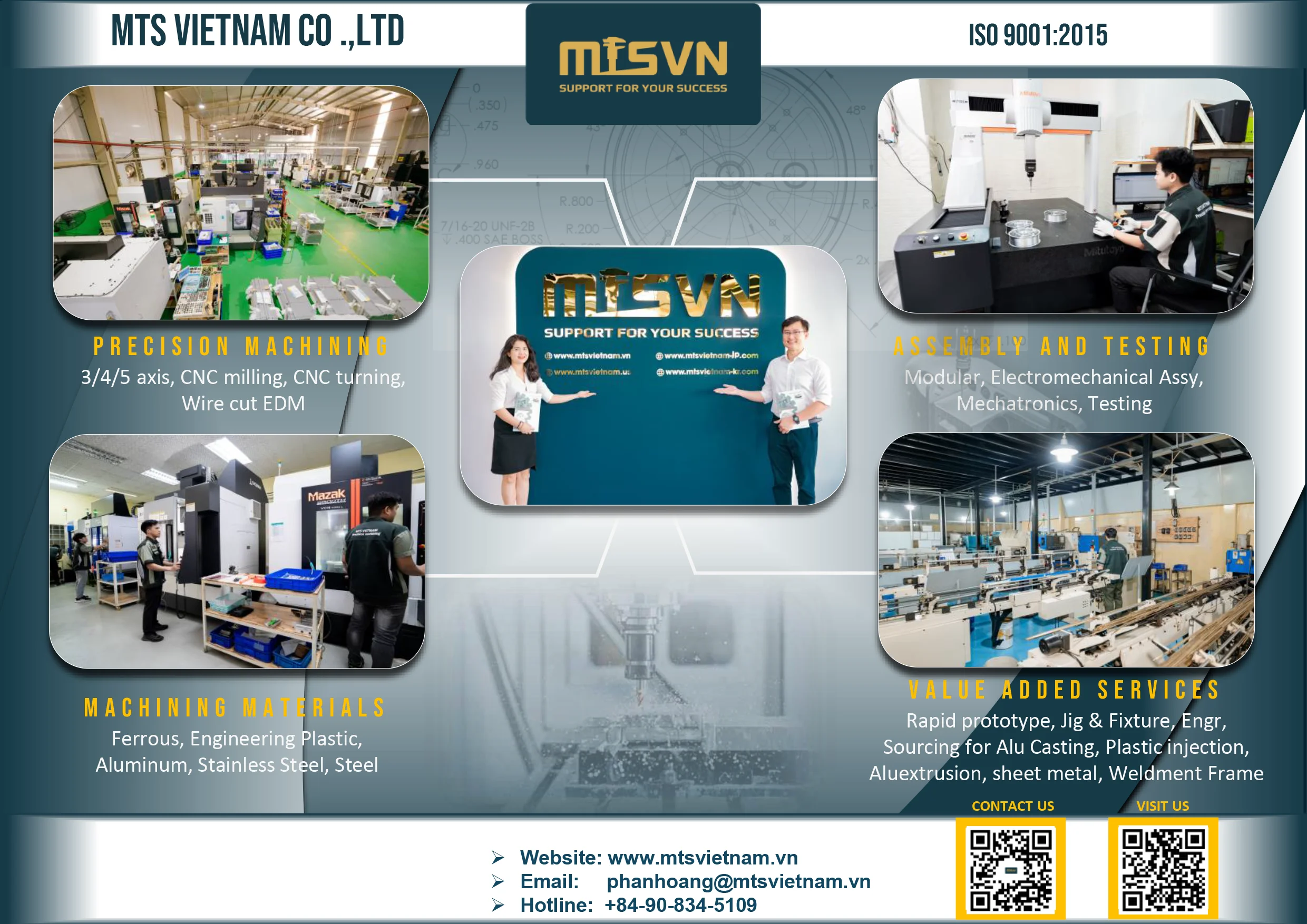
MTS Vietnam is a prominent company specializing in precision mechanical components fabrication. Established in 2017, it has quickly become a reputable name in the Vietnamese and Southeast Asian markets. The company's expertise lies in CNC milling and turning parts made from a variety of materials, including Aluminum, Steel, Stainless, POM, and other engineering plastics. MTS Vietnam is dedicated to supporting the success of its customers and strives to be a leading company in the field of precision mechanical processing both in Vietnam and internationally.
In addition to its fabrication services, MTS Vietnam offers assembly services for components and machines, as well as CNC program services. This comprehensive range of services is aimed at providing optimal solutions and benefits to its customers through the company's ecosystem and strengths. MTS Vietnam emphasizes the importance of investing in new technology and quality control equipment to ensure that it can deliver merchandise at competitive prices and within the required deadlines.
WORKSHOP: 248/10 ĐT743A Street, Binh Thung 1 Quarter, Dong Hoa Ward, Ho Chi Minh City, Vietnam
Tel/zalo/viber: 0908.345.109
Email: phanhoang@mtsvietnam.vn | info@mtsvietnam.vn
Website: www.mtsvietnam.vn (Global Market) | www.mtsvietnam-jp.com (日本)
For USA Sales, please contact MTS USA at:
Tel/zalo/viber: 978-777-1716
Email: sales@mts-usasales.com
Website: www.mtsvietnam.us (US Market)