Introduction
The semiconductor industry is a cornerstone of modern technology, underpinning everything from consumer electronics to advanced computing systems. Precision mechanics and machining play a crucial role in this field, as the manufacture of semiconductor devices requires extremely high levels of accuracy and reliability. This article explores the importance, techniques, and applications of precision machining in the semiconductor industry.
Importance of Precision Machining in the Semiconductor Industry
Precision machining is essential in the semiconductor industry for several reasons:
- High Precision Requirements:
Semiconductor devices feature incredibly small and intricate structures. Machining parts for these devices demands extreme precision, often down to the micron or nanometer scale. - Material Properties:
Components in semiconductor manufacturing must often be made from materials with specific properties, such as high thermal conductivity, electrical insulation, or resistance to corrosion and wear. - Consistency and Reliability:
The semiconductor industry requires consistent and reliable components to ensure the performance and longevity of devices. Precision machining ensures that parts meet strict quality standards. - Complex Geometries:
Semiconductor manufacturing equipment often involves complex geometries that can only be achieved through advanced machining techniques.
Key Machining Techniques in the Semiconductor Industry
- CNC Machining:
- Process: Computer Numerical Control (CNC) machining involves the use of computer-controlled tools to produce precise parts.
- Benefits: Offers high precision, repeatability, and the ability to produce complex geometries.
- Applications: Used for manufacturing semiconductor wafers, components for lithography equipment, and precision fixtures.
- EDM (Electrical Discharge Machining):
- Process: EDM uses electrical discharges (sparks) to remove material from a workpiece.
- Benefits: Capable of machining very hard materials and producing intricate shapes.
- Applications: Ideal for creating fine features in semiconductor molds and dies.
- Ultrasonic Machining:
- Process: Uses high-frequency ultrasonic vibrations to remove material.
- Benefits: Suitable for machining brittle materials like silicon and ceramics without causing damage.
- Applications: Used for drilling and shaping semiconductor wafers and other fragile components.
- Laser Machining:
- Process: Uses focused laser beams to cut or engrave materials.
- Benefits: Offers high precision, minimal material waste, and the ability to machine very fine details.
- Applications: Used for cutting semiconductor wafers, patterning surfaces, and micro-drilling.
- Lapping and Polishing:
- Process: Involves fine abrasive materials to achieve very smooth and flat surfaces.
- Benefits: Provides the high-quality surface finish required for semiconductor wafers and optics.
- Applications: Used for final finishing of wafers and other critical components.
- Semiconductor Wafers:
- Machining: Precision slicing, lapping, and polishing are used to produce high-quality semiconductor wafers.
- Importance: Wafers serve as the substrate for integrated circuits and other semiconductor devices.
- Lithography Equipment:
- Machining: CNC machining and EDM are used to create components for photolithography systems, which are crucial for patterning semiconductor devices.
- Importance: Precision in these components ensures accurate and reliable patterning of semiconductor circuits.
- Etching and Deposition Equipment:
- Machining: Components for etching and deposition equipment are produced using precision machining techniques to ensure tight tolerances and material compatibility.
- Importance: These machines are essential for adding and removing material during semiconductor fabrication.
- Inspection and Metrology Tools:
- Machining: High-precision parts for inspection tools, such as scanning electron microscopes (SEMs) and atomic force microscopes (AFMs), are produced using advanced machining techniques.
- Importance: Accurate inspection and measurement are vital for maintaining quality control in semiconductor manufacturing.
- Packaging and Test Equipment:
- Machining: CNC machining and laser machining are used to produce components for packaging and testing semiconductor devices.
- Importance: Ensures that semiconductor devices are properly packaged and tested for performance and reliability.
Applications of Machined Parts in the Semiconductor Industry
Conclusion
Precision machining is indispensable in the semiconductor industry, where the demand for high precision, material integrity, and complex geometries is paramount. Techniques such as CNC machining, EDM, ultrasonic machining, laser machining, and lapping and polishing play critical roles in producing the components needed for semiconductor manufacturing. As technology advances, the need for even greater precision and reliability in machining parts will continue to grow, driving innovation and excellence in the semiconductor field.
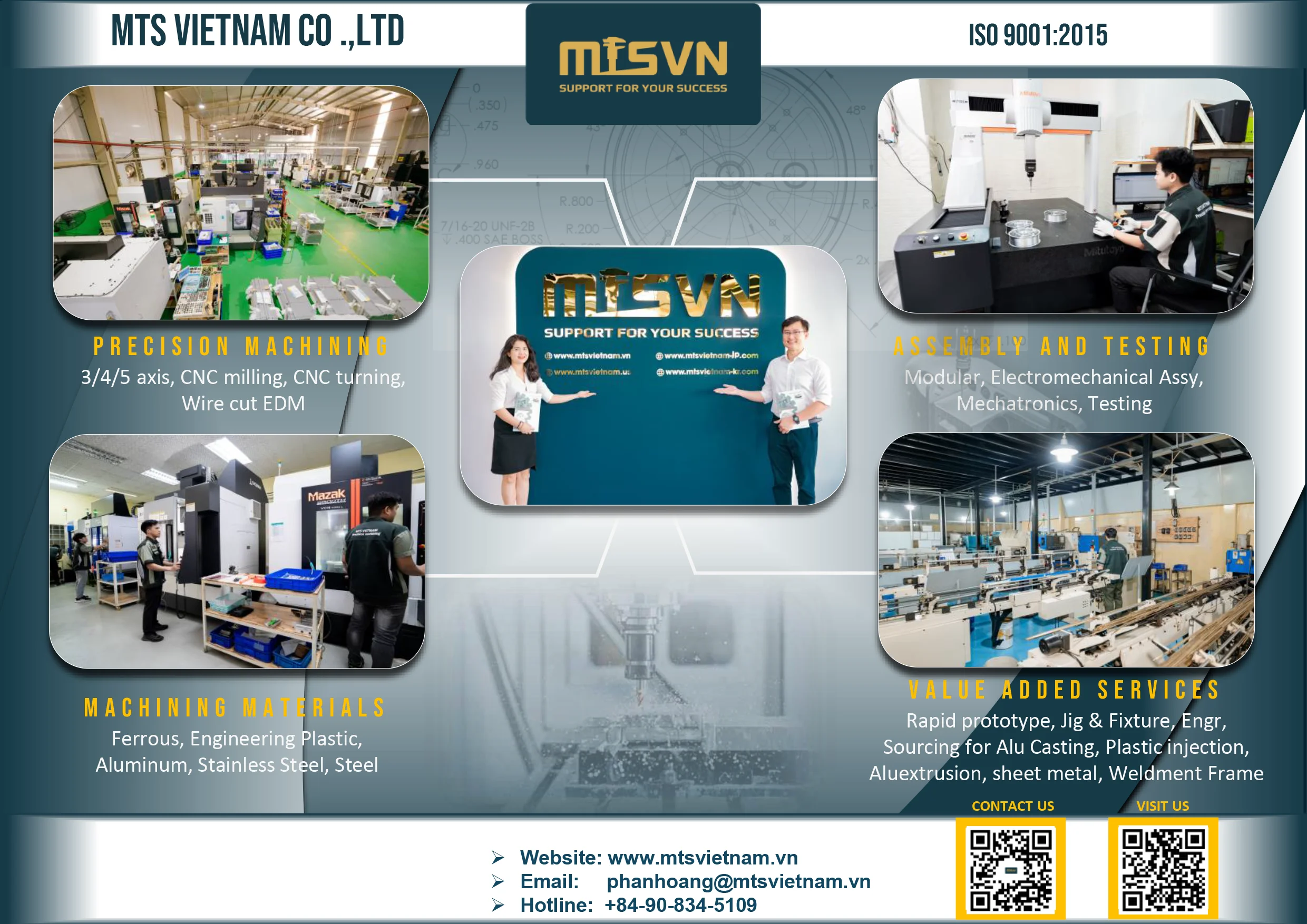
MTS Vietnam is a prominent company specializing in precision mechanical components fabrication. Established in 2017, it has quickly become a reputable name in the Vietnamese and Southeast Asian markets. The company's expertise lies in CNC milling and turning parts made from a variety of materials, including Aluminum, Steel, Stainless, POM, and other engineering plastics. MTS Vietnam is dedicated to supporting the success of its customers and strives to be a leading company in the field of precision mechanical processing both in Vietnam and internationally.
In addition to its fabrication services, MTS Vietnam offers assembly services for components and machines, as well as CNC program services. This comprehensive range of services is aimed at providing optimal solutions and benefits to its customers through the company's ecosystem and strengths. MTS Vietnam emphasizes the importance of investing in new technology and quality control equipment to ensure that it can deliver merchandise at competitive prices and within the required deadlines.
WORKSHOP: 248/10 ĐT743A Street, Binh Thung 1 Quarter, Dong Hoa Ward, Ho Chi Minh City, Vietnam
Tel/zalo/viber: 0908.345.109
Email: phanhoang@mtsvietnam.vn | info@mtsvietnam.vn
Website: www.mtsvietnam.vn (Global Market) | www.mtsvietnam-jp.com (日本)
For USA Sales, please contact MTS USA at:
Tel/zalo/viber: 978-777-1716
Email: sales@mts-usasales.com
Website: www.mtsvietnam.us (US Market)