Introduction
The semiconductor industry is central to the development of modern technology, enabling advancements in electronics, computing, and communications. Lithography equipment is one of the most critical components in semiconductor manufacturing, playing a vital role in the creation of intricate and highly detailed circuit patterns on semiconductor wafers. Precision machined parts are essential for the functionality and accuracy of lithography equipment. This article explores the importance of lithography equipment, the role of precision machining in its production, and its applications in the semiconductor industry.
Understanding Lithography Equipment
Lithography is a process used in semiconductor manufacturing to transfer intricate patterns onto semiconductor wafers. These patterns define the various electronic components and circuits within semiconductor devices. Lithography equipment includes tools and systems that perform this pattern transfer with extreme precision and accuracy.
- Types of Lithography Equipment:
- Photolithography: Uses light to transfer a pattern from a photomask to a light-sensitive photoresist on the wafer surface.
- Electron Beam Lithography: Uses a focused beam of electrons to write patterns directly onto the wafer, offering higher resolution than photolithography.
- Extreme Ultraviolet (EUV) Lithography: Uses extreme ultraviolet light with shorter wavelengths to achieve even finer pattern resolutions.
- Key Components of Lithography Equipment:
- Light Source: Generates the light used for pattern transfer.
- Optical System: Focuses and directs the light onto the wafer.
- Photomask: Contains the pattern to be transferred.
- Stage: Holds and moves the wafer during the lithography process.
- Alignment System: Ensures precise positioning of the wafer and photomask.
Importance of Precision Machining in Lithography Equipment
- High Precision and Accuracy:
- Benefit: Precision machined parts ensure that lithography equipment can achieve the extremely tight tolerances required for semiconductor patterning.
- Impact: Enables the production of intricate and highly detailed circuit patterns essential for modern electronic devices.
- Complex Geometries:
- Benefit: Many components of lithography equipment have complex shapes and fine features that require advanced machining techniques.
- Impact: Supports the development of sophisticated optical systems and alignment mechanisms.
- Material Properties:
- Benefit: Components must be made from materials with specific properties, such as high thermal stability, low thermal expansion, and resistance to wear.
- Impact: Ensures the reliability and longevity of lithography equipment under demanding manufacturing conditions.
- Consistency and Repeatability:
- Benefit: Precision machining provides consistent and repeatable results, producing identical parts across large production runs.
- Impact: Reduces variability and defects, ensuring uniform performance of lithography equipment.
- Surface Finish Quality:
- Benefit: High-quality surface finishes are essential for optical components to reduce light scattering and improve pattern resolution.
- Impact: Enhances the performance and accuracy of the lithography process.
- Optical Components:
- Description: Lenses, mirrors, and other optical elements used to focus and direct light.
- Machining Role: Producing precise geometries and high-quality surface finishes to ensure optimal optical performance.
- Photomask Holders and Stages:
- Description: Mechanisms that hold and move the photomask and wafer with high precision.
- Machining Role: Ensuring tight tolerances and smooth movement to maintain alignment accuracy.
- Alignment Systems:
- Description: Systems that align the wafer and photomask to ensure precise pattern transfer.
- Machining Role: Manufacturing components with high precision to achieve accurate alignment.
- Beam Delivery Systems:
- Description: Components that guide and focus the light or electron beam onto the wafer.
- Machining Role: Creating intricate geometries and high-precision parts to ensure accurate beam delivery.
- Chucks and Clamps:
- Description: Devices that securely hold the wafer in place during the lithography process.
- Machining Role: Producing parts with high accuracy and surface quality to prevent wafer damage and ensure stability.
- Maintaining Tight Tolerances:
- Challenge: Achieving the extremely tight tolerances required for lithography equipment components.
- Solution: Utilizing advanced CNC machining techniques, high-precision tooling, and rigorous quality control measures.
- Surface Finish Requirements:
- Challenge: Ensuring high-quality surface finishes for optical components and other critical parts.
- Solution: Employing fine-grit abrasives, polishing processes, and precision lapping techniques to achieve the desired finish.
- Material Selection and Machining:
- Challenge: Machining materials with specific properties, such as low thermal expansion and high wear resistance.
- Solution: Selecting appropriate materials and optimizing machining parameters to maintain material properties while achieving high precision.
- Component Complexity:
- Challenge: Machining complex geometries and fine features required for advanced lithography equipment.
- Solution: Using multi-axis CNC machines, advanced CAD/CAM software, and skilled machinists to produce intricate parts.
Applications of Machined Parts in Lithography Equipment
Challenges and Solutions in Machining Parts for Lithography Equipment
Conclusion
Lithography equipment is a crucial component of the semiconductor manufacturing process, enabling the precise patterning of semiconductor wafers. The production of high-quality lithography equipment relies heavily on precision machining to achieve the required accuracy, consistency, and surface finish. By supporting the creation of intricate optical systems, alignment mechanisms, and other critical components, precision machining plays an indispensable role in the semiconductor industry. As technology advances and the demand for more sophisticated semiconductor devices grows, the importance of precision machining in the development and production of lithography equipment will continue to be paramount.
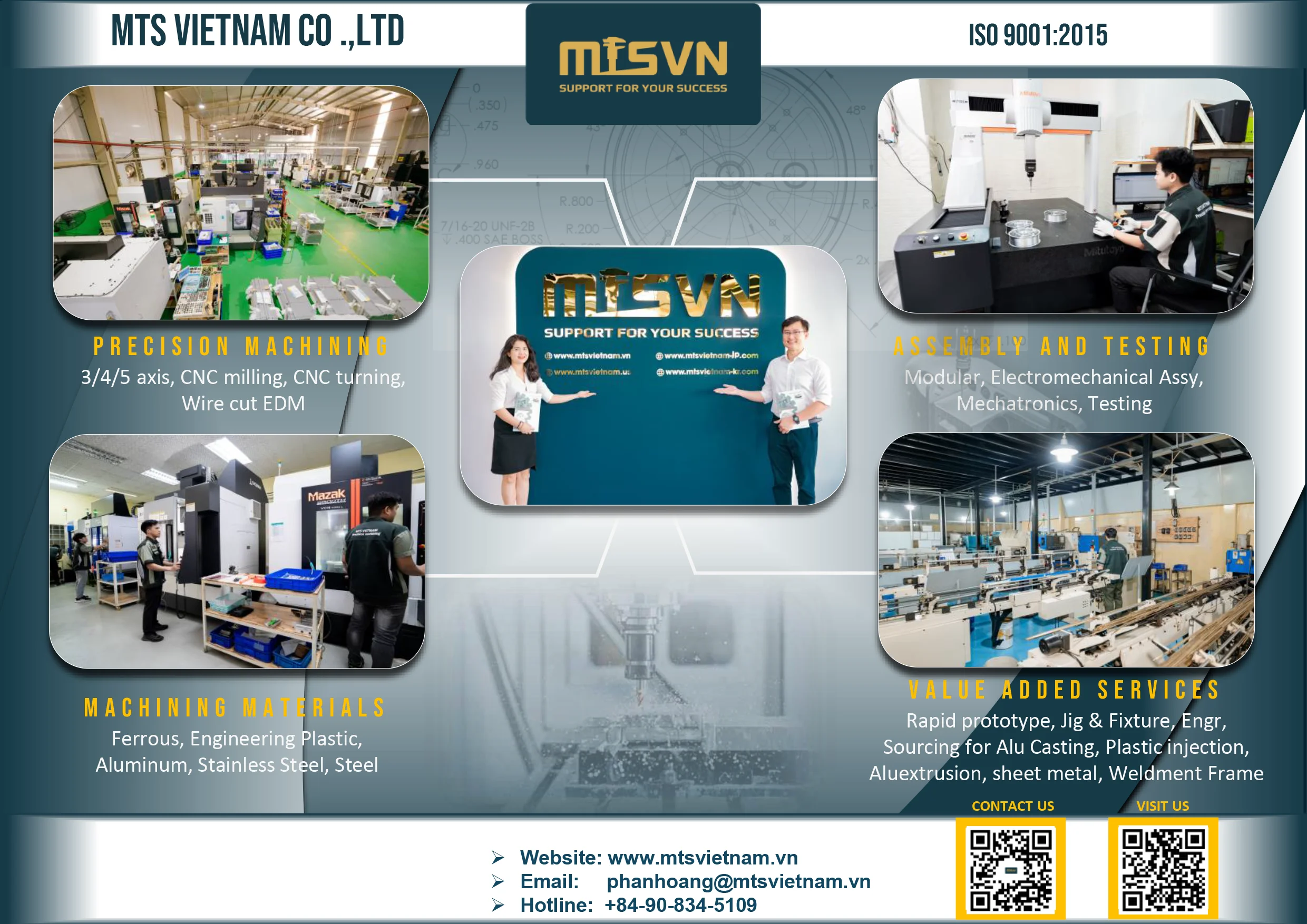
MTS Vietnam is a prominent company specializing in precision mechanical components fabrication. Established in 2017, it has quickly become a reputable name in the Vietnamese and Southeast Asian markets. The company's expertise lies in CNC milling and turning parts made from a variety of materials, including Aluminum, Steel, Stainless, POM, and other engineering plastics. MTS Vietnam is dedicated to supporting the success of its customers and strives to be a leading company in the field of precision mechanical processing both in Vietnam and internationally.
In addition to its fabrication services, MTS Vietnam offers assembly services for components and machines, as well as CNC program services. This comprehensive range of services is aimed at providing optimal solutions and benefits to its customers through the company's ecosystem and strengths. MTS Vietnam emphasizes the importance of investing in new technology and quality control equipment to ensure that it can deliver merchandise at competitive prices and within the required deadlines.
WORKSHOP: 248/10 ĐT743A Street, Binh Thung 1 Quarter, Dong Hoa Ward, Ho Chi Minh City, Vietnam
Tel/zalo/viber: 0908.345.109
Email: phanhoang@mtsvietnam.vn | info@mtsvietnam.vn
Website: www.mtsvietnam.vn (Global Market) | www.mtsvietnam-jp.com (日本)
For USA Sales, please contact MTS USA at:
Tel/zalo/viber: 978-777-1716
Email: sales@mts-usasales.com
Website: www.mtsvietnam.us (US Market)