Introduction
Mechanical fastening is one of the fundamental assembly techniques used in the manufacturing industry to join two or more components securely. This technique involves using mechanical devices such as screws, bolts, nuts, rivets, and clips to assemble parts. Mechanical fastening is essential due to its versatility, reliability, and ease of disassembly, making it suitable for a wide range of applications across various industries. This article explores the mechanical fastening process, its benefits, applications, and its critical role in manufacturing and assembly.
Understanding the Mechanical Fastening Process
Mechanical fastening involves joining components using mechanical fasteners. These fasteners create a physical bond that holds parts together through friction, tension, or compression. The key steps in the mechanical fastening process include:
- Preparation:
- Objective: Ensure that the parts to be joined are clean and properly aligned.
- Methods: Parts are cleaned to remove any contaminants, and holes may be drilled or punched to accommodate the fasteners.
- Fastener Selection:
- Objective: Choose the appropriate fastener based on the material, load requirements, and environmental conditions.
- Methods: Consider the type of fastener (screw, bolt, rivet, etc.), material (steel, aluminum, plastic), and size.
- Assembly:
- Objective: Insert and secure the fasteners to join the components.
- Methods: Fasteners are inserted into pre-drilled holes or through the use of self-tapping screws. Tools such as screwdrivers, wrenches, and rivet guns are used to tighten and secure the fasteners.
- Inspection:
- Objective: Verify that the fasteners are correctly installed and that the assembly is secure.
- Methods: Visual inspections, torque checks, and testing for alignment and fit ensure that the assembly meets quality standards.
Types of Mechanical Fasteners
- Screws:
- Description: Threaded fasteners that create a joint by turning into pre-drilled holes or by tapping their own threads.
- Applications: Used in wood, metal, and plastic assemblies, commonly found in furniture, electronics, and construction.
- Bolts and Nuts:
- Description: Bolts are threaded fasteners that pass through holes in the parts to be joined and are secured with nuts.
- Applications: Used in heavy-duty applications such as machinery, automotive, and structural assemblies.
- Rivets:
- Description: Permanent fasteners that are inserted into pre-drilled holes and deformed to hold parts together.
- Applications: Commonly used in aircraft, automotive, and metal fabrication industries.
- Clips and Clamps:
- Description: Mechanical devices that hold parts together through tension or compression without the need for holes.
- Applications: Used in automotive, plumbing, and electrical assemblies.
- Pins:
- Description: Cylindrical fasteners that are inserted into holes to hold parts in place.
- Applications: Used in machinery, automotive, and aerospace applications for alignment and positioning.
Benefits of Mechanical Fastening
- Versatility:
Mechanical fastening can be used to join a wide variety of materials, including metals, plastics, composites, and wood. - Ease of Assembly and Disassembly: Fasteners allow for easy assembly and disassembly, making repairs, maintenance, and part replacements straightforward and cost-effective.
- Cost-Effective:
Mechanical fastening is generally less expensive than other joining methods, such as welding or adhesive bonding, especially for low to medium production volumes. - Reliability: Fasteners provide strong, durable joints that can withstand significant loads and environmental conditions.
- No Heat Requirement:
Unlike welding, mechanical fastening does not require heat, making it suitable for joining heat-sensitive materials. - Minimal Surface Preparation:
Mechanical fastening typically requires less surface preparation compared to other joining methods, such as adhesive bonding.
Applications of Mechanical Fastening
- Automotive Industry:
- Applications: Assembling body panels, engine components, interior parts, and electrical systems.
- Benefits: Provides strong, reliable joints that can be easily disassembled for repairs and maintenance.
- Aerospace Industry:
- Applications: Joining aircraft structures, fuselage panels, and interior components.
- Benefits: Ensures high-strength, lightweight connections that can withstand extreme conditions.
- Construction Industry:
- Applications: Structural steel connections, framing, and roofing assemblies.
- Benefits: Offers durable, load-bearing joints that are easy to install and maintain.
- Electronics Industry:
- Applications: Securing circuit boards, enclosures, and components.
- Benefits: Provides reliable connections that allow for easy assembly and repair of electronic devices.
- Consumer Goods:
- Applications: Assembling furniture, appliances, toys, and sporting goods.
- Benefits: Offers flexible and cost-effective solutions for assembling a wide range of products.
- Machinery and Equipment:
- Applications: Joining parts in industrial machinery, tools, and equipment.
- Benefits: Ensures robust, long-lasting connections that can withstand heavy use and harsh environments.
Conclusion
Mechanical fastening is a key assembly technique that provides versatile, reliable, and cost-effective solutions for joining various materials. Its ease of assembly and disassembly, coupled with the ability to create strong, durable joints, makes it essential in numerous industries, from automotive and aerospace to construction and electronics. As technology advances, mechanical fastening techniques will continue to evolve, further enhancing their capabilities and expanding their applications in the manufacturing landscape.
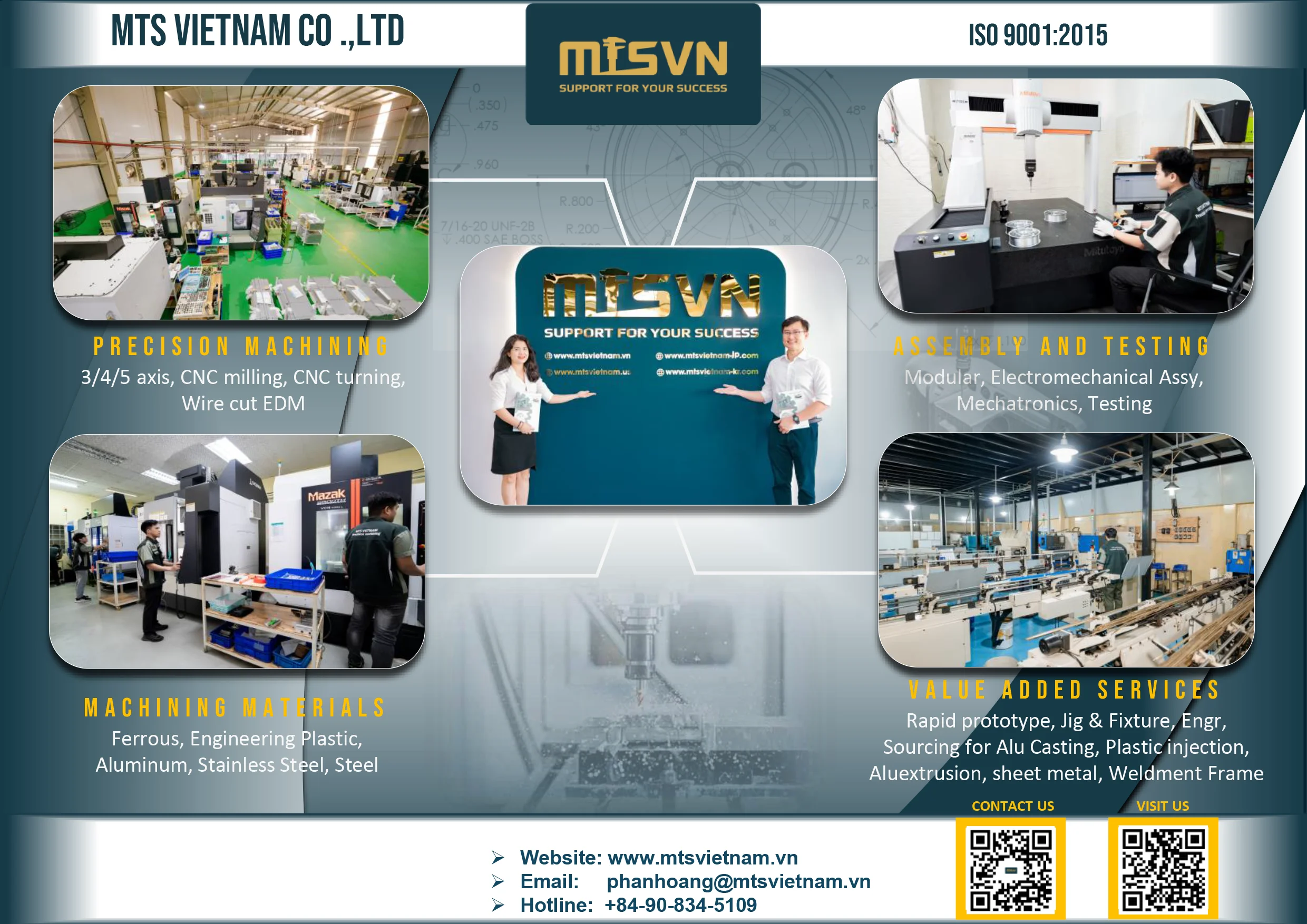
MTS Vietnam is a prominent company specializing in precision mechanical components fabrication. Established in 2017, it has quickly become a reputable name in the Vietnamese and Southeast Asian markets. The company's expertise lies in CNC milling and turning parts made from a variety of materials, including Aluminum, Steel, Stainless, POM, and other engineering plastics. MTS Vietnam is dedicated to supporting the success of its customers and strives to be a leading company in the field of precision mechanical processing both in Vietnam and internationally.
In addition to its fabrication services, MTS Vietnam offers assembly services for components and machines, as well as CNC program services. This comprehensive range of services is aimed at providing optimal solutions and benefits to its customers through the company's ecosystem and strengths. MTS Vietnam emphasizes the importance of investing in new technology and quality control equipment to ensure that it can deliver merchandise at competitive prices and within the required deadlines.
WORKSHOP: 248/10 ĐT743A Street, Binh Thung 1 Quarter, Dong Hoa Ward, Ho Chi Minh City, Vietnam
Tel/zalo/viber: 0908.345.109
Email: phanhoang@mtsvietnam.vn | info@mtsvietnam.vn
Website: www.mtsvietnam.vn (Global Market) | www.mtsvietnam-jp.com (日本)
For USA Sales, please contact MTS USA at:
Tel/zalo/viber: 978-777-1716
Email: sales@mts-usasales.com
Website: www.mtsvietnam.us (US Market)