Introduction
The semiconductor industry, a cornerstone of modern technology, requires machining techniques that can deliver high precision, intricate details, and the ability to work with fragile materials. Ultrasonic machining (USM) is one such technique that excels in these areas. This non-traditional machining process is particularly effective for brittle and hard materials, making it ideal for semiconductor manufacturing. This article explores the role of ultrasonic machining in the semiconductor industry, its benefits, applications, and why it is considered a key machining technique.
Understanding Ultrasonic Machining
Ultrasonic machining (USM) involves the use of high-frequency ultrasonic vibrations to remove material from a workpiece. This process is particularly suited for brittle and hard materials, such as ceramics, glass, and silicon, which are commonly used in the semiconductor industry.
How Ultrasonic Machining Works:
- Setup: The workpiece is secured in place, and a tool vibrates at ultrasonic frequencies (typically 20 kHz to 40 kHz). The tool is usually made of a material harder than the workpiece.
- Operation: An abrasive slurry (a mixture of abrasive particles and a liquid) is fed into the machining zone. The high-frequency vibrations of the tool cause the abrasive particles to impact the workpiece surface, removing material through micro-chipping and erosion.
- Material Removal: The material is gradually eroded away in the areas of impact, allowing for precise and intricate shaping of the workpiece.
Benefits of Ultrasonic Machining in the Semiconductor Industry
- Machining of Brittle Materials:
- Benefit: USM can effectively machine brittle materials without causing cracks or damage.
- Impact: Enables the production of delicate semiconductor components from materials like silicon, quartz, and glass.
- High Precision and Accuracy:
- Benefit: USM offers high precision and accuracy, capable of achieving tight tolerances and fine details.
- Impact: Ensures that semiconductor components meet the exacting standards required for optimal performance.
- Complex Geometries:
- Benefit: USM can create intricate shapes and fine features that are difficult to achieve with traditional machining methods.
- Impact: Supports the development of advanced semiconductor devices with complex geometries and functionalities.
- Minimal Thermal Effects:
- Benefit: USM generates minimal heat during the machining process, preventing thermal damage to the workpiece.
- Impact: Maintains the integrity and properties of heat-sensitive semiconductor materials.
- No Mechanical Stress:
- Benefit: USM is a non-contact process, which means there is no physical force applied to the workpiece.
- Impact: Prevents deformation and damage, preserving the precision and quality of fragile components.
Applications of Ultrasonic Machining in the Semiconductor Industry
- Microelectromechanical Systems (MEMS):
- Description: MEMS devices consist of tiny mechanical components that interact with electronic circuits.
- USM Role: Produces intricate and precise features, such as micro-channels, micro-holes, and complex 3D structures, essential for MEMS functionality.
- Semiconductor Wafers:
- Description: Thin slices of semiconductor material used as the substrate for integrated circuits and other semiconductor devices.
- USM Role: Precision cutting, drilling, and shaping of wafers to ensure uniform thickness, smooth edges, and intricate patterns.
- Optoelectronic Components:
- Description: Devices that interact with light, such as LEDs, photodetectors, and laser diodes.
- USM Role: Machining of optical lenses, waveguides, and other components with high precision and fine details to enhance optical performance.
- Ceramic Substrates:
- Description: Insulating materials used in semiconductor devices to support and connect electronic components.
- USM Role: Drilling, shaping, and patterning of ceramic substrates with precision to create pathways for electrical connections.
- Packaging Components:
- Description: Materials and structures used to protect semiconductor devices and ensure their reliability.
- USM Role: Machining of complex packaging components, such as housings and connectors, with high precision and fine features.
Challenges and Solutions in Ultrasonic Machining for the Semiconductor Industry
- Tool Wear:
- Challenge: The tool in USM can wear down over time, affecting precision and accuracy.
- Solution: Using high-quality tool materials and optimizing machining parameters to minimize wear and maintain precision.
- Abrasive Slurry Management:
- Challenge: Proper handling and disposal of the abrasive slurry are required to prevent contamination and environmental impact.
- Solution: Implementing effective slurry management systems and recycling methods to handle and dispose of slurry safely.
- Surface Finish Quality:
- Challenge: Achieving the desired surface finish can be challenging due to the abrasive nature of the process.
- Solution: Using fine-grit abrasives and optimizing machining parameters to achieve smoother surface finishes.
- Machining Speed:
- Challenge: USM can be slower compared to traditional machining methods.
- Solution: Optimizing process parameters and using advanced ultrasonic equipment to improve machining speed without compromising precision.
Conclusion
Ultrasonic machining (USM) is a key technique in the semiconductor industry, providing the precision, accuracy, and capability to machine brittle and hard materials essential for semiconductor manufacturing. Its ability to create complex geometries and fine details, coupled with minimal thermal effects and no mechanical stress, makes it indispensable for producing high-quality semiconductor components. As the demand for advanced and miniaturized semiconductor devices continues to grow, USM will remain a critical process, driving innovation and excellence in the semiconductor industry.
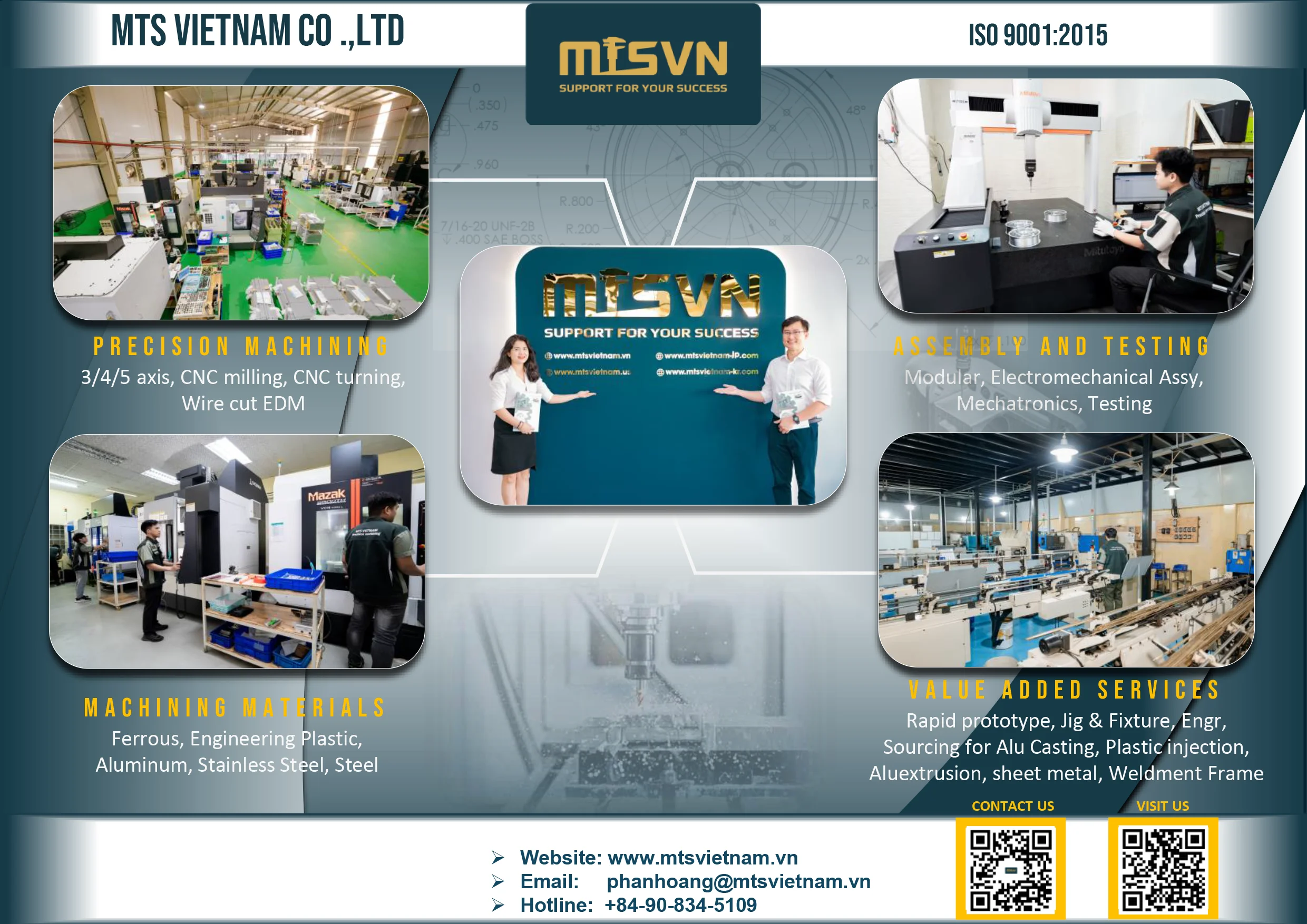
MTS Vietnam is a prominent company specializing in precision mechanical components fabrication. Established in 2017, it has quickly become a reputable name in the Vietnamese and Southeast Asian markets. The company's expertise lies in CNC milling and turning parts made from a variety of materials, including Aluminum, Steel, Stainless, POM, and other engineering plastics. MTS Vietnam is dedicated to supporting the success of its customers and strives to be a leading company in the field of precision mechanical processing both in Vietnam and internationally.
In addition to its fabrication services, MTS Vietnam offers assembly services for components and machines, as well as CNC program services. This comprehensive range of services is aimed at providing optimal solutions and benefits to its customers through the company's ecosystem and strengths. MTS Vietnam emphasizes the importance of investing in new technology and quality control equipment to ensure that it can deliver merchandise at competitive prices and within the required deadlines.
WORKSHOP: 248/10 ĐT743A Street, Binh Thung 1 Quarter, Dong Hoa Ward, Ho Chi Minh City, Vietnam
Tel/zalo/viber: 0908.345.109
Email: phanhoang@mtsvietnam.vn | info@mtsvietnam.vn
Website: www.mtsvietnam.vn (Global Market) | www.mtsvietnam-jp.com (日本)
For USA Sales, please contact MTS USA at:
Tel/zalo/viber: 978-777-1716
Email: sales@mts-usasales.com
Website: www.mtsvietnam.us (US Market)