Introduction
Miniaturization in the medical field has become increasingly important as the demand for less invasive procedures and portable medical devices grows. Precision machining plays a crucial role in achieving the miniaturization of medical components, ensuring they meet stringent specifications for performance, reliability, and safety. This article explores the importance of miniaturization in the medical field and how precision machining contributes to this critical aspect.
The Need for Miniaturization in the Medical Field
- Minimally Invasive Procedures:
- Importance: Minimally invasive procedures reduce patient trauma, shorten recovery times, and lower the risk of complications compared to traditional surgical methods.
- Examples: Laparoscopic surgeries, catheter-based interventions, and endoscopic procedures.
- Impact: Smaller and more precise medical instruments are essential for performing these advanced procedures effectively.
- Implantable Devices:
- Importance: Implantable devices must be compact and reliable to minimize discomfort and enhance patient outcomes.
- Examples: Pacemakers, neurostimulators, and insulin pumps.
- Impact: Miniaturized components are critical for fitting these devices within the body without interfering with normal physiological functions.
- Portable and Wearable Medical Devices:
- Importance: Portable and wearable devices enable continuous monitoring and treatment, improving patient care and convenience.
- Examples: Glucose monitors, portable ECG devices, and wearable fitness trackers.
- Impact: The miniaturization of these devices makes them more comfortable and user-friendly, encouraging consistent use.
- Precision Diagnostics:
- Importance: Smaller diagnostic tools can access hard-to-reach areas within the body, providing more accurate and detailed information.
- Examples: Miniaturized ultrasound probes, microendoscopes, and lab-on-a-chip devices.
- Impact: Enhances the accuracy and efficiency of diagnostic procedures, leading to better patient outcomes.
Precision Machining Techniques for Achieving Miniaturization
- CNC Machining:
- Description: Computer Numerical Control (CNC) machining uses computer-controlled tools to produce parts with high precision.
- Capabilities: Can create complex 3D shapes and intricate features with tight tolerances.
- Applications: Manufacturing miniaturized surgical instruments, implantable devices, and diagnostic tools.
- Electrical Discharge Machining (EDM):
- Description: EDM uses electrical discharges to erode material from a workpiece, ideal for hard materials and intricate shapes.
- Capabilities: Produces fine details and complex internal geometries.
- Applications: Producing small and intricate components for cardiovascular devices and implantable neurostimulators.
- Laser Machining:
- Description: Uses focused laser beams to cut or engrave materials with high precision.
- Capabilities: Creates detailed features and complex patterns on small-scale medical components.
- Applications: Crafting detailed features on catheters, microfluidic devices, and surgical tools.
- Micro Milling and Drilling:
- Description: Uses specialized tools to create very small holes and features in materials.
- Capabilities: Achieves high precision and smooth finishes on miniature parts.
- Applications: Manufacturing micro-scale components for medical diagnostics and implants.
- Additive Manufacturing (3D Printing):
- Description: Builds components layer by layer using various materials, allowing for complex geometries.
- Capabilities: Creates intricate and customized shapes that are difficult to achieve with traditional machining.
- Applications: Producing custom prosthetics, dental implants, and patient-specific surgical guides.
Benefits of Precision Machining for Miniaturization in Medical Devices
- High Precision and Accuracy:
- Benefit: Precision machining achieves extremely tight tolerances and high dimensional accuracy.
- Impact: Ensures that miniaturized components meet exact specifications, enhancing the functionality and reliability of medical devices.
- Complex Geometries:
- Benefit: Advanced machining techniques allow for the creation of intricate and detailed features on small-scale components.
- Impact: Supports the development of sophisticated medical devices with enhanced capabilities.
- Material Compatibility:
- Benefit: Precision machining can work with a wide range of biocompatible materials, including metals, polymers, and ceramics.
- Impact: Ensures that miniaturized medical devices are safe for use in the human body.
- Surface Finish Quality:
- Benefit: Techniques such as polishing and lapping provide smooth, high-quality surface finishes on miniature parts.
- Impact: Reduces the risk of tissue irritation and bacterial colonization, improving the safety and performance of implantable devices.
- Customization and Personalization:
- Benefit: Advanced machining techniques enable the creation of customized medical devices tailored to individual patient needs.
- Impact: Improves patient outcomes by providing better-fitting and more effective solutions.
Applications of Miniaturized Components in Medical Devices
- Surgical Instruments:
- Description: Tools used in minimally invasive procedures requiring high precision and reliability.
- Machining Role: Producing intricate and sharp features on small-scale instruments, ensuring durability and sterility.
- Implantable Devices:
- Description: Devices such as pacemakers, neurostimulators, and insulin pumps used to treat chronic conditions.
- Machining Role: Manufacturing miniaturized components with biocompatible materials, ensuring a perfect fit and long-term performance.
- Diagnostic Equipment:
- Description: Devices used for precision diagnostics, such as miniaturized ultrasound probes and lab-on-a-chip devices.
- Machining Role: Creating high-precision components that ensure the accuracy and reliability of diagnostic readings.
- Wearable Medical Devices:
- Description: Portable devices used for continuous monitoring and treatment, such as glucose monitors and ECG devices.
- Machining Role: Producing compact and reliable components that enhance user comfort and device functionality.
- Microfluidic Devices:
- Description: Devices that manipulate small volumes of fluids for applications in diagnostics and drug delivery.
- Machining Role: Crafting intricate channels and chambers with high precision, essential for accurate fluid control and analysis.
Challenges and Solutions in Achieving Miniaturization through Precision Machining
- Maintaining Tight Tolerances:
- Challenge: Achieving the extremely tight tolerances required for miniature components.
- Solution: Utilizing advanced CNC machining techniques, high-precision tooling, and rigorous quality control measures.
- Material Handling:
- Challenge: Machining hard or brittle materials used in medical devices.
- Solution: Using specialized machining techniques such as EDM and laser machining to handle challenging materials effectively.
- Surface Finish Requirements:
- Challenge: Ensuring high-quality surface finishes on small-scale components to prevent tissue damage and bacterial colonization.
- Solution: Employing fine abrasives, polishing processes, and precision lapping to achieve smooth surfaces.
- Component Complexity:
- Challenge: Machining complex geometries and fine features on miniature parts.
- Solution: Using multi-axis CNC machines, advanced CAD/CAM software, and skilled machinists to produce intricate designs.
Conclusion
Miniaturization is a critical aspect of the medical field, driving the development of advanced medical devices that are smaller, more precise, and more effective. Precision machining plays an essential role in achieving the miniaturization of medical components, ensuring they meet stringent specifications for performance, reliability, and safety. Techniques such as CNC machining, EDM, laser machining, micro milling, and additive manufacturing enable the production of intricate and high-quality miniature parts for surgical instruments, implantable devices, diagnostic equipment, wearable medical devices, and microfluidic devices. As the demand for less invasive procedures and portable medical technology continues to grow, the importance of precision machining in achieving miniaturization will remain crucial, driving innovation and improving patient outcomes.
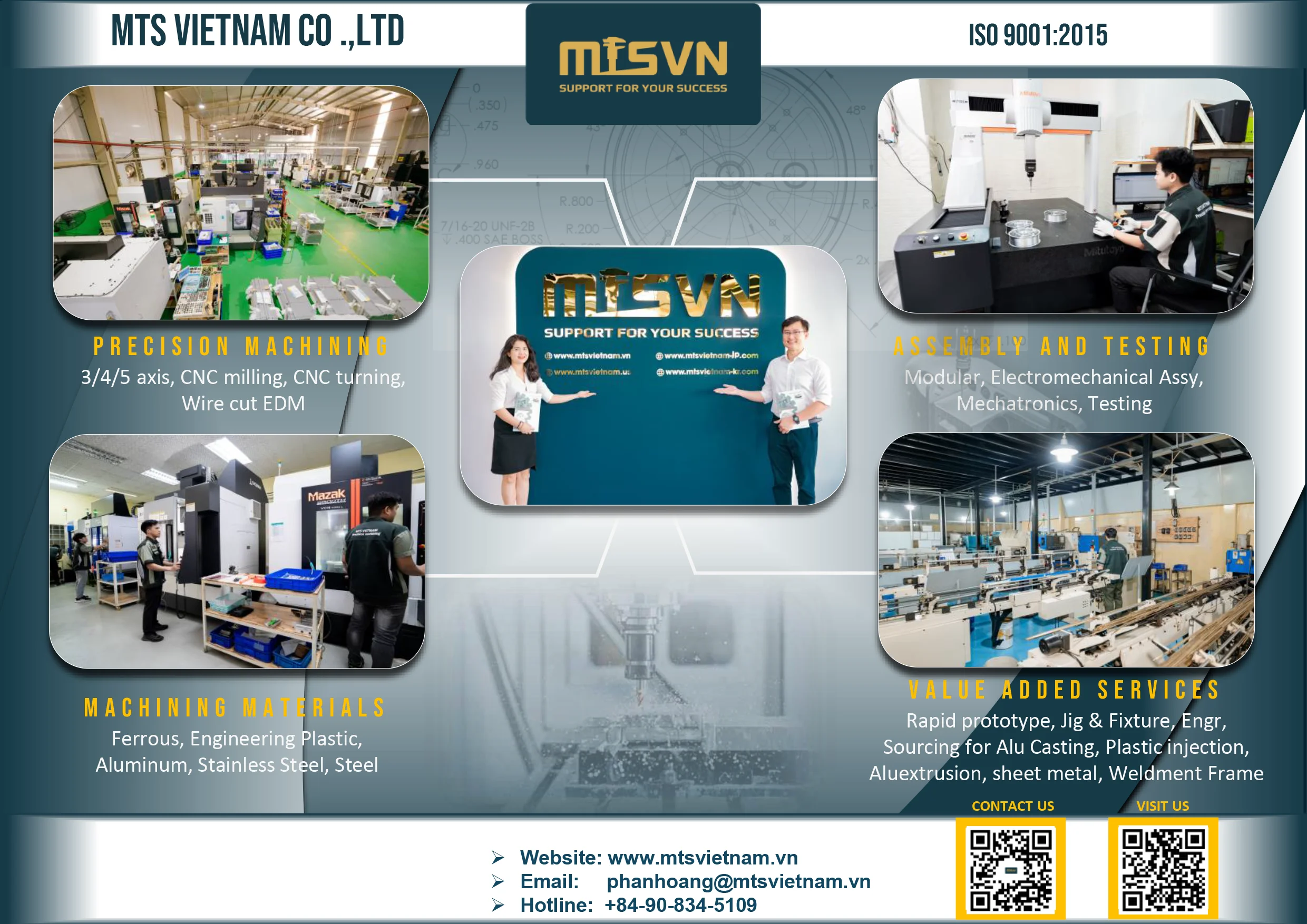
MTS Vietnam is a prominent company specializing in precision mechanical components fabrication. Established in 2017, it has quickly become a reputable name in the Vietnamese and Southeast Asian markets. The company's expertise lies in CNC milling and turning parts made from a variety of materials, including Aluminum, Steel, Stainless, POM, and other engineering plastics. MTS Vietnam is dedicated to supporting the success of its customers and strives to be a leading company in the field of precision mechanical processing both in Vietnam and internationally.
In addition to its fabrication services, MTS Vietnam offers assembly services for components and machines, as well as CNC program services. This comprehensive range of services is aimed at providing optimal solutions and benefits to its customers through the company's ecosystem and strengths. MTS Vietnam emphasizes the importance of investing in new technology and quality control equipment to ensure that it can deliver merchandise at competitive prices and within the required deadlines.
WORKSHOP: 248/10 ĐT743A Street, Binh Thung 1 Quarter, Dong Hoa Ward, Ho Chi Minh City, Vietnam
Tel/zalo/viber: 0908.345.109
Email: phanhoang@mtsvietnam.vn | info@mtsvietnam.vn
Website: www.mtsvietnam.vn (Global Market) | www.mtsvietnam-jp.com (日本)
For USA Sales, please contact MTS USA at:
Tel/zalo/viber: 978-777-1716
Email: sales@mts-usasales.com
Website: www.mtsvietnam.us (US Market)