Introduction
The semiconductor industry is at the heart of modern technological advancements, driving innovations in electronics, computing, and communications. One of the critical machining techniques that support this industry is Computer Numerical Control (CNC) machining. CNC machining provides the precision, consistency, and flexibility needed to produce the intricate components essential for semiconductor devices. This article explores the role of CNC machining in the semiconductor industry, its benefits, applications, and why it is a key technique for manufacturing semiconductor components.
Understanding CNC Machining
CNC machining involves the use of computer-controlled machines to perform a wide range of manufacturing processes, including milling, turning, drilling, and grinding. CNC machines are programmed using computer-aided design (CAD) and computer-aided manufacturing (CAM) software to create precise and complex parts with high repeatability and accuracy.
- How CNC Machining Works:
- Programming: The process begins with creating a digital design of the component using CAD software. This design is then converted into a set of instructions (G-code) that the CNC machine can follow.
- Setup: The workpiece is securely clamped onto the machine's worktable. Tools required for the machining process are selected and loaded into the machine's tool holder.
- Machining: The CNC machine follows the programmed instructions, moving the workpiece and cutting tools in multiple axes to shape the material into the desired form.
- Finishing: Post-machining processes such as polishing, cleaning, and inspection ensure that the final product meets the required specifications and quality standards.
Benefits of CNC Machining in the Semiconductor Industry
- High Precision and Accuracy:
- Benefit: CNC machines can achieve extremely tight tolerances and produce parts with high dimensional accuracy.
- Impact: Ensures that semiconductor components meet the exact specifications required for optimal performance and reliability.
- Consistency and Repeatability:
- Benefit: CNC machining provides consistent results, producing identical parts across large production runs.
- Impact: Reduces variability and defects, ensuring uniform quality and reliability of semiconductor components.
- Complex Geometries:
- Benefit: CNC machines can create intricate and complex geometries that are often required for semiconductor devices.
- Impact: Supports the development of advanced semiconductor components with multiple functionalities.
- Flexibility:
- Benefit: CNC machining can work with a wide range of materials, including metals, plastics, and ceramics.
- Impact: Allows manufacturers to produce diverse semiconductor components tailored to specific applications.
- Efficiency and Speed:
- Benefit: CNC machines can operate continuously and produce parts quickly.
- Impact: Increases production efficiency and reduces lead times, enabling faster time-to-market for semiconductor products.
- Automation and Integration:
- Benefit: CNC machines can be integrated with other automated systems, such as robotic arms and inspection tools.
- Impact: Enhances manufacturing efficiency and reduces labor costs, while maintaining high precision and quality.
Applications of CNC Machining in the Semiconductor Industry
- Semiconductor Wafers:
- Description: Thin slices of semiconductor material, such as silicon, used as the substrate for semiconductor devices.
- CNC Machining Role: Precision slicing, grinding, and polishing to achieve uniform thickness and smooth surfaces essential for wafer processing.
- Lithography Equipment Components:
- Description: Equipment used to transfer patterns onto semiconductor wafers.
- CNC Machining Role: Manufacturing of precision parts such as reticles, masks, and alignment systems that require high accuracy and fine details.
- Etching and Deposition Equipment Parts:
- Description: Tools used in the etching and deposition processes to create microstructures on semiconductor wafers.
- CNC Machining Role: Producing high-precision components like nozzles, chambers, and electrodes that are critical for process accuracy and consistency.
- Heat Sinks and Thermal Management Components:
- Description: Devices that dissipate heat generated by semiconductor components.
- CNC Machining Role: Machining of complex fin structures and intricate shapes to enhance thermal performance and fit within tight spaces.
- Connectors and Housings:
- Description: Mechanical and electrical interfaces for semiconductor devices.
- CNC Machining Role: Creating precise, durable, and reliable components that ensure proper connectivity and protection.
- Inspection and Metrology Tools:
- Description: Instruments used to measure and inspect semiconductor components.
- CNC Machining Role: Manufacturing of high-precision parts that contribute to the accuracy and reliability of inspection systems.
Challenges and Solutions in CNC Machining for the Semiconductor Industry
- Maintaining Tight Tolerances:
- Challenge: Achieving the extremely tight tolerances required for semiconductor components.
- Solution: Using advanced CNC machines with high-resolution feedback systems and implementing rigorous quality control measures.
- Material Properties:
- Challenge: Machining materials with unique properties, such as brittleness or hardness.
- Solution: Selecting appropriate tooling, optimizing machining parameters, and using specialized techniques like EDM or ultrasonic machining.
- Surface Finish Quality:
- Challenge: Ensuring that machined surfaces meet the required finish specifications.
- Solution: Employing fine-grit abrasives, polishing processes, and precise control over machining conditions to achieve the desired surface quality.
- Cost and Efficiency:
- Challenge: Balancing the need for precision with cost-effectiveness and efficiency.
- Solution: Implementing automated systems, optimizing tool paths, and using advanced software for simulation and process optimization.
Conclusion
CNC machining is a key technique in the semiconductor industry, providing the precision, consistency, and flexibility needed to manufacture complex and high-performance components. Its ability to produce intricate geometries with tight tolerances ensures that semiconductor devices meet stringent performance and reliability standards. As the semiconductor industry continues to evolve and advance, CNC machining will remain an essential process, driving innovation and supporting the development of next-generation technologies.
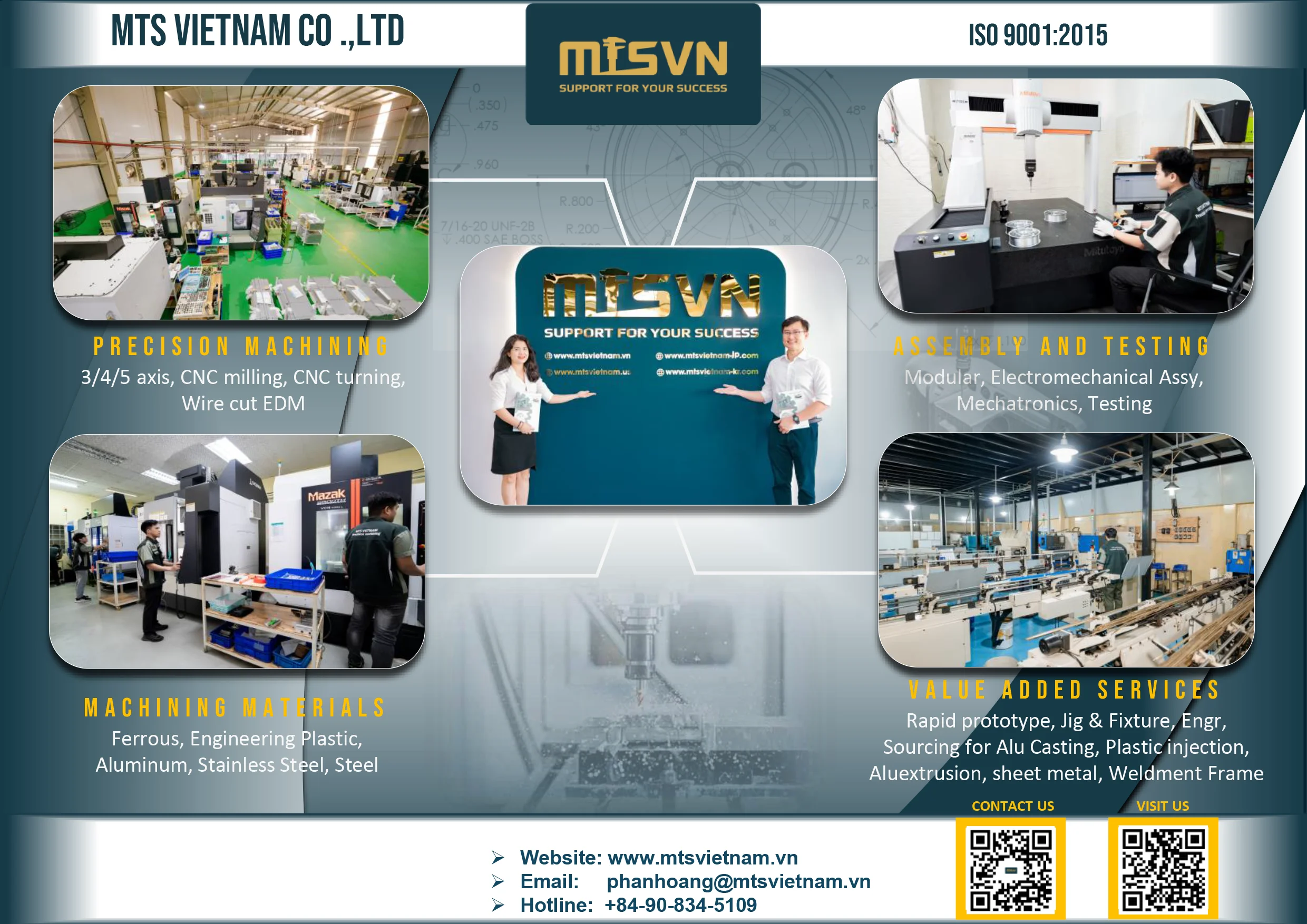
MTS Vietnam is a prominent company specializing in precision mechanical components fabrication. Established in 2017, it has quickly become a reputable name in the Vietnamese and Southeast Asian markets. The company's expertise lies in CNC milling and turning parts made from a variety of materials, including Aluminum, Steel, Stainless, POM, and other engineering plastics. MTS Vietnam is dedicated to supporting the success of its customers and strives to be a leading company in the field of precision mechanical processing both in Vietnam and internationally.
In addition to its fabrication services, MTS Vietnam offers assembly services for components and machines, as well as CNC program services. This comprehensive range of services is aimed at providing optimal solutions and benefits to its customers through the company's ecosystem and strengths. MTS Vietnam emphasizes the importance of investing in new technology and quality control equipment to ensure that it can deliver merchandise at competitive prices and within the required deadlines.
WORKSHOP: 248/10 ĐT743A Street, Binh Thung 1 Quarter, Dong Hoa Ward, Ho Chi Minh City, Vietnam
Tel/zalo/viber: 0908.345.109
Email: phanhoang@mtsvietnam.vn | info@mtsvietnam.vn
Website: www.mtsvietnam.vn (Global Market) | www.mtsvietnam-jp.com (日本)
For USA Sales, please contact MTS USA at:
Tel/zalo/viber: 978-777-1716
Email: sales@mts-usasales.com
Website: www.mtsvietnam.us (US Market)